

Key Takeaways
- All of your cryptocurrency disposals should be reported on Form 8949.
- To complete your Form 8949, you’ll need a complete record of your cryptocurrency transactions including your gains and losses.
- A crypto tax software like CoinLedger can auto-generate a completed Form 8949!
In this guide, we’ll share everything you need to know about Form 8949 before you get started filing your taxes. We’ll also break down step-by-step instructions on how to report your cryptocurrency disposals on your tax return.
What tax form should I use to report cryptocurrency and NFTs?
In the United States, crypto is taxed as income and capital gains. How your crypto is taxed and reported depends on the nature of your income.
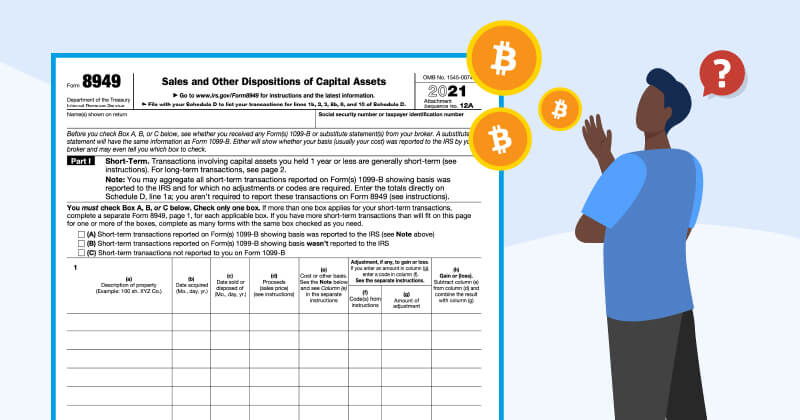
Form 8949 for crypto disposals: If you dispose of crypto-assets, such as selling them, trading them away, or using them to make a purchase, you should report your disposal on Form 8949. Then, your net gain/loss should be reported on Schedule D.
Schedule 1 for crypto income: If you’re an individual taxpayer who earned crypto-assets as income or rewards, such as staking and mining rewards, you should report your earnings as income on Schedule 1 as an individual taxpayer.
Who has to fill out Form 8949 for cryptocurrency?
You should report your cryptocurrency on Form 8949 in the following situations:
- I made a profit while selling/trading cryptocurrency/NFTs
- I made a loss while selling/trading cryptocurrency/NFTs
- I used cryptocurrency to make a purchase
One exception to these rules is if you’re buying and selling cryptocurrency in a self-directed crypto IRA. These accounts are tax-advantaged and as a result, these trades should not be reported on Form 8949.
Can I just copy my capital gains and losses from Form 1099-DA?
In 2026, crypto investors are receiving Form 1099-DA, a form designed to report capital gains and losses from cryptocurrency. When Form 1099-DA is issued to taxpayers, an additional copy is filed with the IRS.
Remember, Form 1099-DA is informational. While it’s a good starting point for filing your taxes, it’s not a final source of truth.
If you receive Form 1099-DA, you should check to make sure the proceeds in your records match the proceeds numbers reported on the form. Remember, major discrepancies here can lead to further investigation by the IRS.
However, for the 2025 tax year, exchanges are not required to track and report cost basis to the IRS. That means your cost basis information on Form 1099-DA may be inaccurate. If you find yourself in this situation, don’t panic. Cost basis mismatches are common, and you can simply report your correct cost basis on Form 8949.
Why is cost basis wrong on my Form 1099-DA?
Typically, cost basis errors occur if you transfer crypto between wallets and exchanges.
What do I do if my cost basis is wrong?
There’s no need to request a corrected Form 1099-DA for cost basis errors.
If your cost basis is incorrect on Form 1099-DA, you can simply report the correct cost basis on Form 8949. All you need is proper documentation of your original purchase (whether from your exchange, bank statements, or your crypto tax software).
How to fill out Form 8949 in 6 steps
Here’s a 6-step process on how to report your cryptocurrency and NFT disposals on Form 8949.
Step 1. Take into account all of your disposal events
The first step to filling out your Form 8949 is to take account of every one of your cryptocurrency and NFT disposals during the tax year.
Remember, each one of your disposals across your wallets and exchanges need to be reported on Form 8949. Examples of disposals include selling your cryptocurrency or NFTs, trading your crypto assets away, or using cryptocurrency to purchase goods or services.
Step 2. Collect information on your cryptocurrency disposals
To report your cryptocurrency and NFT disposals on Form 8949, you’ll need the following information:
- A description of the property you sold (ex. 1.5 BTC)
- The date you originally acquired the property
- The date you sold or disposed of the property
- Proceeds from your crypto disposal
- Your cost basis for purchasing the property
- Your gain or loss
If you received a Form 1099-DA, it’s recommended that you copy the proceeds numbers on the form, as this is reported to the IRS.
However, you should calculate and report cost basis numbers on your own.
Again, exchanges are currently not required to track and report cost basis. That means that as long as you have backing documentation, you won’t run into issues if you report different cost basis numbers than Form 1099-DA.
If you want extra help reporting your crypto transactions, consider CoinLedger Done For You. A CoinLedger tax expert will work with you one-on-one to answer any questions, help you report your transaction data, and generate a complete tax report.
Step 3. Divide your transactions into short-term and long-term disposals
Form 8949 is divided into two sections: short-term and long-term. You should take note of which of your disposals fall into which category.
If you dispose of your assets after holding them for less than 12 months, they should be reported on the short-term section. If you dispose of your assets after holding them for more than 12 months, they should be reported on the long-term section.
Long-term disposals are subject to more favorable tax rates.
.jpeg)
Remember, the acquisition date of your cryptocurrency may be incorrect on Form 1099-DA (especially if you transferred crypto from another wallet/exchange). In cases like these, you can simply report the correct acquisition date for your cryptocurrency using your own records.
Step 4. Select the correct option
In both the short-term and long-term sections, you’ll need to select one of three checkboxes. Here are the options in Part I.

If you received Form 1099-DA, you should select option G or H, depending on whether your exchange reported cost basis on your transactions. For the 2025 tax year, exchanges are not required to report cost basis, which means that you’ll want to select H in most cases.
Step 5. Report your disposals on Form 8949
Now, you can get started recording your cryptocurrency disposals on Form 8949.
To better understand how to fill out the form, let’s take a look at a sample transaction history.
Here’s how Ben’s transactions would be reported on Form 8949.

In some cases, your Form 1099-DA may have an inaccurate cost basis. In cases like this, you can use code B in column (f) and make an adjustment based on your gain/loss calculation from your crypto tax software.
There's no need to fill out columns (f)and (g) if your Form 1099-DA did not report cost basis.
Pro Tip: If you disposed of ‘collectible’ NFTs during the tax year, you may want to report your short-term and long-term gains and losses from these assets on a separate Form 8949. Collectible NFTs are subject to a different tax rate. For more information, check out our guide to NFT taxes.
Step 6. Report your net gain or loss on Schedule D
Once you’ve finished reporting your disposals on Form 8949, you are required to report your net short-term and long-term capital gains/losses on Schedule D.

If you have any capital losses from prior years that you wish to carry forward, you can report them here.
How to generate a Form 8949 with crypto tax software
Looking for an easier way to fill out Form 8949? Crypto tax software like CoinLedger can help.
With CoinLedger, you can connect to your wallets and exchanges and import your transactions in minutes! Once you’re done, you'll have a complete record of your cost basis across wallets and exchanges, and you can download completed IRS forms like Form 8949!
Get started with a free CoinLedger account today.
Do I have to fill out Form 8949 if I didn’t receive a 1099 form?
If you didn’t receive a 1099 form, you are still required to fill out Form 8949 if you have disposed of crypto during the tax year.
Remember, all of your taxable income from cryptocurrency should be reported on your tax return. Failure to do so is considered tax evasion, a serious crime with serious consequences.
How can I add my cryptocurrency Form 8949 to TurboTax?
If you’re using TurboTax or TaxAct to file your tax return, CoinLedger can help you generate a cryptocurrency capital gains report that can be imported into either platform.
What should I do if I have too many transactions on Form 8949?
In some cases, platforms like TurboTax limit the number of transactions you can report on Form 8949.
Remember, you are required to report all of your taxable disposals to the IRS. Taxpayers have the option to report consolidated total amounts on Form 8949 and provide an attached report with all the required details.
CoinLedger can help you generate a consolidated capital gains report you can import into your tax platform of choice. You can then mail in a detailed record of your cryptocurrency disposals to the IRS.
For more information, read our guide on how to mail in Form 8949.
Get started with CoinLedger
Want to generate comprehensive capital gains and income tax reports in minutes? CoinLedger can help.
More than 700,000 investors around the world use CoinLedger to simplify the tax reporting process. With integrations to the world’s biggest exchanges, the platform can save you hours of effort during tax season.
Frequently asked questions
- Is cryptocurrency reported to the IRS?


- How do I report cryptocurrency on Form 8949?
- Is crypto reported on Schedule D?
- How much tax do I pay on Form 8949 transactions?
- Can I get a Form 8949 from Coinbase?
- Do I have to report every transaction on Form 8949?
- Is Form 8949 required for crypto if I got Form 1099-DA?
- When not to use Form 8949?
- What form do I need to report cryptocurrency on taxes?
- Who fills out a Form 8949 for crypto?


.png)
How we reviewed this article
All CoinLedger articles go through a rigorous review process before publication. Learn more about the CoinLedger Editorial Process.


CoinLedger has strict sourcing guidelines for our content. Our content is based on direct interviews with tax experts, guidance from tax agencies, and articles from reputable news outlets.