

Key Takeaways
- Claiming crypto losses comes with tax benefits. Capital losses can offset an unlimited amount of gains and up to $3,000 of ordinary income for the year.
- Currently, the wash sale rule doesn’t apply to cryptocurrency. That means you can sell your cryptocurrency, claim a loss, and buy it back within 30 days.
In this guide, we’ll break down everything you need to know about cryptocurrency tax-loss harvesting. We’ll explain how it works and share a simple step-by-step process to help you get started saving money on your tax return today.
What is tax-loss harvesting?
If you sell your stocks, real estate assets, or cryptocurrencies at a profit, you’ll be required to pay capital gains tax based on how much money you’ve made from the sale.
Some investors choose to reduce their capital gains in a given tax year by selling some of their assets at a loss. This is called tax-loss harvesting.
How tax-loss harvesting works
Tax-loss harvesting is a very common strategy in the world of stocks and securities. To get a better understanding of how it works, let’s look at an example.
Without Tax Loss Harvesting
Here’s how much John incurs in capital gains if he decides not to take advantage of tax-loss harvesting.
With Tax Loss Harvesting
If John decides to sell his losing position, he can reduce his tax bill.
Tax-loss harvesting with cryptocurrencies
Just like stocks, cryptocurrencies can be used for tax-loss harvesting. You can strategically sell/trade crypto to harvest losses and reduce your tax liability.
Unlike stocks however, cryptocurrencies have unique characteristics that make them even better candidates for tax-loss harvesting. Let’s go through some of these advantages.
Does the wash sale rule apply to cryptocurrency?
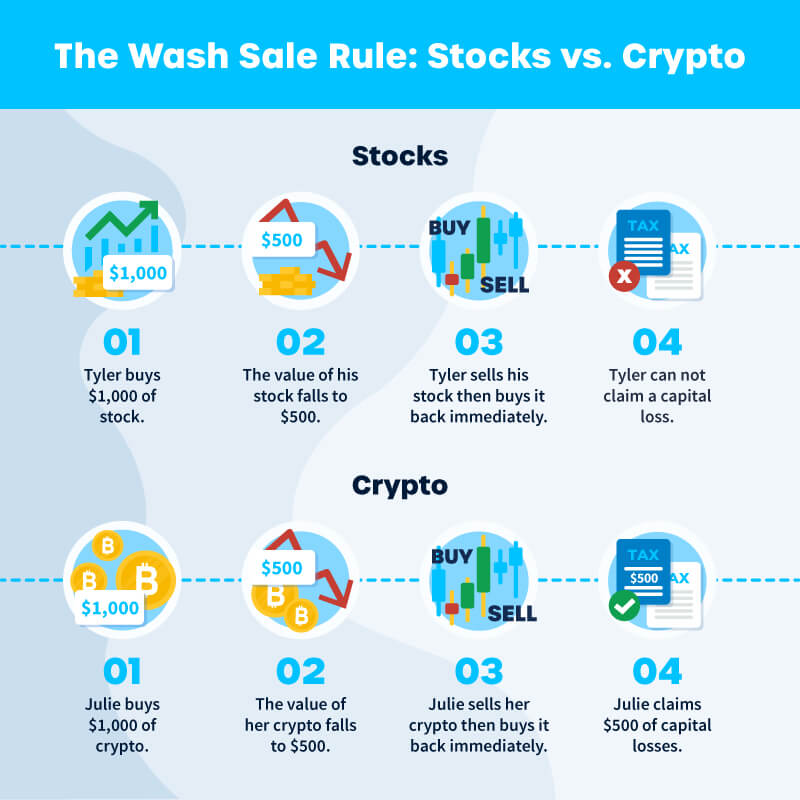
Right now, the IRS has a ‘wash sale rule’ in place that’s designed to prevent investors from taking capital losses and then immediately buying back the same stock. Claiming a capital loss on a stock is not allowed if you buy the same security 30 days before or after the sale.
The IRS specifically states that wash sale rules only apply to securities. Cryptocurrencies are property, not securities, as defined by IRS guidance. This means that as of now, it’s likely that the wash sale rule does not apply to cryptocurrencies.
Volatility and tax loss harvesting
Cryptocurrencies are extremely volatile, and often fluctuate in price more than stocks. This volatility means that crypto investors have more opportunities to realize and harvest capital losses.
The difficult part for investors is identifying which of the cryptocurrencies in their portfolio have the highest cost basis (original purchase price) when compared to the current market price. These are the assets that present the greatest opportunity for tax savings.
At the end of this article, we’ll share a step-by-step strategy for identifying tax-loss harvesting opportunities. Before jumping into that, let’s dive deeper into how tax-loss harvesting works.
Tax-loss harvesting: Long-term vs. short term gains
When you harvest your crypto losses, it’s important to keep track of how long you held your cryptocurrency.
If you disposed of your crypto after more than a year of holding, it will be considered a ‘long-term capital loss’. If you disposed of your crypto after less than a year, it will be considered a ‘short-term capital loss’.
It’s important to remember that short-term capital losses first offset short-term capital gains, and long-term capital losses first offset long-term capital gains. If you have any net capital losses remaining, it can then be used to offset capital gains of the other type.
Is there a limit to crypto tax-loss harvesting?
Whenever total capital gains and losses for the year add up to a negative number, a net capital loss is incurred.
If the net capital loss (after your gains are offset) is less than or equal to $3,000 ($1,500 if you are married and filing a separate tax return), then you can use your capital loss to offset other types of income. This includes income from your job.
If you have a net loss more than $3,000, it will get rolled forward to future years.
What is economic substance doctrine?
While the wash sale rule does not apply to cryptocurrency, it’s important to keep in mind the economic substance doctrine.
The economic substance doctrine is a tax rule that allows the IRS to disregard a transaction for tax purposes if it lacks a genuine purpose beyond generating tax benefits.
It’s likely that selling crypto, claiming a loss, and buying it back seconds later could be disallowed under the economic substance doctrine.
However, buying back cryptocurrency after a few days could be reasonably argued to have risk and ‘economic substance’ due to the volatility of the crypto market.
How often should I harvest my crypto losses?
Many investors choose to wait until the end of the tax year to identify tax-loss harvesting opportunities and minimize their capital gains.
This strategy is not ideal.
Because cryptocurrencies are so volatile, investors often have multiple opportunities to take advantage of tax-loss harvesting over the course of a year. Regularly taking advantage of these price dips can help investors save money and reduce stress at the end of a tax year.
What are the risks of tax-loss harvesting?
If you find yourself in one of these scenarios, tax-loss harvesting may not be right for you.
- You are planning to liquidate your holdings soon: If you are planning to sell off your holdings in the near future, you may want to be cautious about harvesting your losses. If you do sell your tokens within the next 12 months, you will need to pay the short-term capital gains rate (10-37%). The long-term capital gains rate (0-20%) only applies if you’ve held your tokens for longer than 12 months.
- Your tax savings do not cover exchange fees: Before pursuing a tax-loss harvesting strategy, it’s important to consider exchange fees. It’s possible that the price to sell and rebuy your tokens is higher than your potential tax savings.
- Your long-term capital gains are already 0: If you’re single and making under $48,350 or married and making under $96,700, your long-term capital gains tax rate is already 0%. While tax-loss harvesting will not reduce your long-term capital gains tax, it can still offset your short-term gains and up to $3,000 of income.
Can I do tax-loss harvesting with NFTs?
NFTs are considered a type of crypto-asset, and are generally subject to similar tax rules as cryptocurrencies.
Similar to cryptocurrencies, you incur capital losses when you sell NFTs at a loss. It’s reasonable to assume that at this time, the wash sale rule does not apply to NFTs.
CoinLedger can help you identify your NFT tax-loss harvesting opportunities. Just plug in your Ethereum wallet and let the platform take care of the rest.
What if I bought my crypto at multiple price points?
Consider the following question in the infographic below.
The answer depends on what accounting method Brian chooses to use for his crypto transactions. In the United States, investors typically use the first-in first-out (FIFO) accounting method to calculate their crypto gains and losses. In this case, the first cryptocurrency you receive also becomes the first that you dispose of.
If Brian uses the FIFO method, he incurs a capital loss of $5,000 ($40,000 - $35,000).
Other accounting methods such as last-in first-out (LIFO) or highest-in first-out (HIFO) also exist. These methods require investors to be able to specifically identify the cryptocurrency that they’re selling.
How can I get started with tax-loss harvesting?
Want to start saving money on your taxes?
CoinLedger can help. The platform connects with your wallets and exchanges and allows you to find all your tax-loss harvesting opportunities in minutes.
Let’s walk through the process.
1. Connect your wallets and exchanges: Connect your wallets and exchanges and import your transactions.
2. Generate your tax report: Double check your information, then generate a tax report with the click of a button!
3. Navigate to the tax-loss harvesting tab: Here, you’ll be able to see all your tax-loss harvesting opportunities. The list is sorted by how large your opportunity is.
.png)
See how much tax-loss harvesting reduces your tax bill.
Once you know which cryptocurrencies present the best tax savings opportunities, you can sell or trade them on your exchange of choice.
Then, import the transaction(s) into CoinLedger and re-run your tax reports! You will then be able to see how much harvesting that loss reduced your net gains.
What’s the deadline for tax-loss harvesting?
It is important to keep in mind that in the U.S. the tax year ends on Dec. 31st, even though the filing deadline isn’t until April 15th. If you want to claim losses this tax year, you’ll need to take action before New Year’s Day.
If you wait too long to dispose of your cryptocurrency losses, you may miss out on the opportunity to offset your capital gains for the current year. Remember, you are not allowed to carry your losses back to previous tax years.
If you’re looking for an easy way to identify your tax-savings opportunities, get started with CoinLedger for free. More than 700,000 investors around the world use the platform to generate a tax report in minutes and save thousands of dollars through tax-loss harvesting.
Frequently asked questions
- Do I have to pay taxes if I sell crypto at a loss?


- Should I harvest my crypto losses for my taxes?
- Does the wash sale rule apply to cryptocurrency?
- Can I use LIFO for cryptocurrency?
- Is there a limit to tax-loss harvesting?
- Is tax-loss harvesting a form of tax evasion?


.png)
How we reviewed this article
All CoinLedger articles go through a rigorous review process before publication. Learn more about the CoinLedger Editorial Process.


CoinLedger has strict sourcing guidelines for our content. Our content is based on direct interviews with tax experts, guidance from tax agencies, and articles from reputable news outlets.