Got a 1099-DA? Here’s Why It’s Incomplete (And What to Do)



Key Takeaways
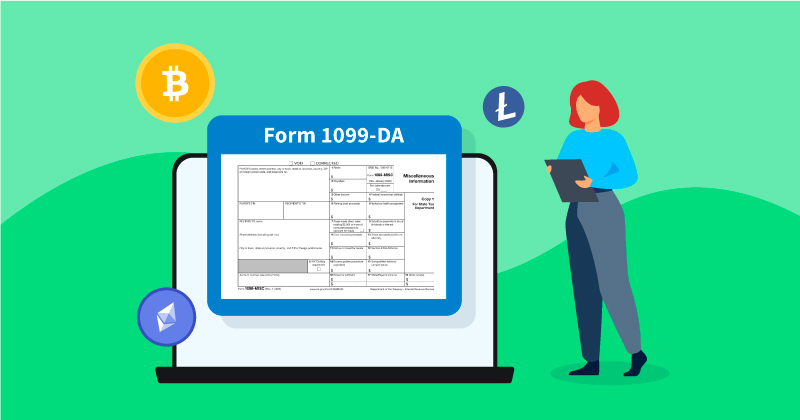
- Cryptocurrency exchanges are required to issue Form 1099-DA to customers and the IRS. The form contains a record of your capital gains & losses from cryptocurrency, and a copy is filed with the IRS.
- For the 2025 tax year, exchanges are not required to track and report cost basis. Cost basis info on Form 1099-DA will likely be inaccurate if you transferred crypto in/out of your exchange. You can report the correct cost basis on your tax return, as long as you have records to back it up.
If you’re buying and selling cryptocurrency in the United States, your exchange will soon issue Form 1099-DA to report your capital gains to the IRS.
In this blog, we’ll break down what Form 1099-DA is and what it means for your cryptocurrency taxes.
What is Form 1099-DA (Digital Asset)?
Form 1099s are used to report non-employment income (income you receive outside of your job) to the IRS. You may have received forms like Form 1099-B in the past to report gains and losses from stocks.
Form 1099-DA (Digital Asset) is a new tax form designed specifically to help taxpayers report gains and losses from cryptocurrencies and other digital assets.
As of 2026, cryptocurrency exchanges are required to issue Form 1099-DA to users for all capital gains and losses. When you receive a Form 1099-DA or another 1099 form, an identical copy is filed with the IRS.
At this time, cryptocurrency exchanges are not required to track and report cost basis to the IRS. That means that cost basis information on Form 1099-DA can be inaccurate/incomplete (more on this below).
What should I do when I receive Form 1099-DA?
When you receive your Form 1099-DA, you should do the following:
- Double-check to make sure that you’ve reported all of the disposals on the form, and the proceeds numbers on the forms closely match the proceeds numbers in your own records.
- If the form is inaccurate, you may have to request a corrected Form 1099-DA from your exchange. Remember, this form is issued to the IRS. Taking proactive steps now can prevent issues in the future.
It’s important to remember that there’s no need to request a corrected form if Form 1099-DA has inaccurate data about your cost basis (more on this below).
What do I do if my Form 1099-DA doesn’t include my cost basis?
If your Form 1099-DA doesn’t include/contains inaccurate information about cost basis, don’t panic.
For the 2025 tax year, exchanges were not required to track cost basis.
Under current IRS guidelines, you are allowed to report your own cost basis from cryptocurrency transactions on Form 8949 as long as you have supporting documentation (such as records from your exchanges or your crypto tax software).
Here’s how CoinLedger can help you accurately track your cost basis and report your gains and losses:
- Sign in to your CoinLedger account.
- Connect your wallets and exchanges, and let the platform automatically calculate your gains and losses.
- Download Form 8949. This form will contain the gain/loss information from your CoinLedger account. In most cases, you’ll want to check Box H (as of 2026, exchanges are not required to report cost basis to the IRS).

Then, send your Form 8949 to your accountant or export it to platforms like TurboTax.
Want to get started reporting your crypto taxes? Get started with a free CoinLedger account today.
Why is my Form 1099-DA incomplete?
To better understand why exchanges aren’t reporting cost basis to the IRS, let’s discuss the difference between covered and non-covered assets.
What is a covered asset?
A covered asset is any cryptocurrency you purchase on or after January 1, 2026, within a centralized exchange (CeFi exchange).
Exchanges are responsible for keeping track of the cost basis of covered assets and reporting this information to the IRS starting with the 2026 tax year (for 1099 forms sent in 2027).
What is a non-covered asset?
A non-covered asset is an asset that exchanges are not responsible for tracking. This includes:
- Any cryptocurrency you purchased before January 1, 2026 on any exchange
- Any cryptocurrency that is transferred into an exchange from a self-custodial wallet
- Any cryptocurrency that is transferred into an exchange from another exchange
You are 100% responsible for keeping track of the cost basis for non-covered assets.
Why does this matter?
Exchanges have no legal requirement to track or report cost basis for non-covered assets to the IRS.
If you received a Form 1099-DA for activity in the 2025 tax year, all the assets contained within the form are non-covered assets. That means exchanges are not required to track cost basis, and it’s possible that your cost basis won’t be reported on the form at all.
Sarah is responsible for proving she originally bought the BTC for $40,000 (her cost basis). If she doesn’t have the records, she may be responsible for paying capital gains taxes on the full $100,000 instead of the actual $60,000 gain.
If you find yourself in this situation, consider using crypto tax software like CoinLedger to automatically track the cost basis of your assets and generate an accurate record of your taxable income across your wallets and exchanges. This can help you avoid overpaying your taxes.
What information does Form 1099-DA report?
Form 1099-DA has the information needed to calculate your capital gains and losses. It contains fields on the following:
- Digital asset identification
- Your account number
- The name of the digital asset
- The number of units of the digital assets involved in the transaction
- When you received the digital asset (acquisition date)
- When you disposed of the digital asset (sale or disposition date)
- How much you paid for the digital asset (cost basis) [for assets acquired after January 1, 2026 only]
- How much you received for disposing of the digital asset (proceeds)
It's important to note that some of these fields (like cost basis) are only reported to customers, not the IRS.
Who receives Form 1099-DA?
If you make a transaction with cryptocurrency that resulted in a capital gain or loss starting in the 2025 tax year, you should expect to receive Form 1099-DA.
There is no minimum threshold for receiving Form 1099-DA. Some investors have reported receiving the form for less than a dollar of capital gain.
When will I receive Form 1099-DA?
Form 1099-DA reporting requirements went into effect starting from January 1, 2025. That means that 2026 is the first year that cryptocurrency exchanges issued the form (for the previous tax year).
Typically, exchanges issue Form 1099-DA in mid-February. However, some exchanges have delayed issuing the form until mid-March.
It’s important to remember that many exchanges already report taxable income to the IRS. Currently, cryptocurrency exchanges send a variety of 1099 forms to customers including Form 1099-MISC and Form 1099-B.
Will Form 1099-DA lead to more tax audits?
Form 1099-DA will give more information than ever on cryptocurrency gains and losses to the IRS. According to experts, the introduction of Form 1099-DA could lead to an unprecedented wave of crypto tax audits.
It’s likely that if there’s a discrepancy between how much you paid in tax and what’s been reported to the IRS, you’ll automatically receive a CP2000 warning letter from the IRS.
Failure to address the warning letter will likely result in penalties and potentially an audit.
Who is required to report Form 1099-DA?
All ‘cryptocurrency brokers’ are required to issue Form 1099-DA. Based on the Treasury Department’s guidance, this will include:
- Centralized exchanges
- Decentralized exchanges
- Certain wallets that allow users to buy, sell, and trade cryptocurrencies
- Bitcoin ATMs and physical kiosks
At this time, decentralized exchanges are not required to issue Form 1099-DA.
Who is not required to report Form 1099-DA?
The following parties are not considered cryptocurrency brokers:
- Miners, node operators, other parties who validate transactions on the blockchain
- Software developers who indirectly facilitate transactions through centralized exchanges or smart contracts
These parties are not required to issue Form 1099-DA to users.
Are stablecoins and NFTs reported on Form 1099-DA?
Based on IRS guidance, it’s likely that stablecoin and NFT transactions will be reported to the IRS on Form 1099-DA if your gross proceeds reach the following thresholds:
- Stablecoins: $10,000+
- NFTs: $600+
Remember, you are required to report all of your stablecoin and NFT transactions on your tax return, regardless of whether or not you reach the reporting threshold.
What do I do if my crypto tax software shows different proceeds than my Form 1099-DA?
In some situations, your crypto tax software may show a different amount of proceeds from a sale/disposal than your Form 1099-DA. This is a common issue due to price source differences and API gaps.
It’s unlikely that a minor discrepancy such as this will lead to issues with the IRS. However, the conservative approach is to make sure what you report on your tax return is the same as what has been reported to the IRS on Form 1099-DA.
CoinLedger allows you to edit your transactions manually within the platform to make sure that your proceeds match those reported on Form 1099-DA.
What do I do if my Form 1099-DA is completely wrong?
In rare cases, your Form 1099-DA may show transactions that never occurred or grossly inaccurate proceeds numbers.
In cases like these, you should take the following steps:
- Contact your exchange’s support: Request a corrected 1099-DA and document your attempts to resolve the issue. This shows good faith effort if the IRS contacts you about any discrepancies.
- Consider filing an extension: Filing for a tax extension gives you more time to get a corrected form. Remember, you are still required to make an estimated tax payment before April 15 if you choose this option.
- File with accurate information: Report your corrected figures on Form 8949. You can attach a brief explanation noting the error and the steps you took to fix it.
Again, there’s no need to request a corrected Form 1099-DA if your cost basis numbers are inaccurate.
What happens if I don’t report income reported on Form 1099-DA?
Remember, not reporting transactions reported on Form 1099-DA is tax evasion.
It’s likely that you’ll automatically receive a warning letter from the IRS about your unpaid tax liability. Failure to pay can result in fines, penalties, and even a potential audit.
To avoid issues with the IRS, you should match the proceeds numbers on Form 1099-DA (or if these numbers are grossly inaccurate, request a corrected form).
Will 1099-DA change how crypto tax reporting works?
Because of mandatory 1099-DA reporting, the IRS now requires that taxpayers use the per-wallet method to track capital gains and losses.
Previously, taxpayers were allowed to use the ‘universal method’, which assumed all of your cryptocurrency came from the same tax lot.
To better understand the differences between the universal method and the per-wallet method, let’s take a look at an example.
With universal method: With the previous universal method, Brian’s ETH on Exchange A and Exchange B would be treated as one tax lot. If Brian was using the First-In First-Out method, the first ETH he acquired would be the first that he disposes of, regardless of where he originally purchased it. In this case, Brian would report his capital gain as $1,200 ($3,200-2,000).
With per wallet method: With the per wallet method, the ETH on Exchange A and Exchange B are considered two separate lots for tax purposes. Because Brian is selling his BTC on Exchange B, he must use his cost basis for his BTC held on Exchange B. As a result, Brian’s capital gain is $200 ($3,200- 3,000).
The IRS shifted to the per-wallet method so that it would be easier to track taxpayers’ capital gains and losses from each individual cryptocurrency platform.
Even after the shift to the per-wallet method, your Form 1099-DA may still be inaccurate if you transferred crypto across wallets/exchanges. To track your capital gains and losses, you’ll need your original cost for acquiring your cryptocurrency.
Will Form 1099-DA cause issues if I haven’t reported crypto in the past?
If you haven’t reported your crypto taxes in the past, you should submit a crypto tax amendment to avoid potential fines. Once Form 1099-DA requirements go into effect, it’s likely that the IRS will discover your previously unreported cryptocurrency income.
Remember, the IRS is generally lenient to taxpayers who willingly come forward about unreported income.
Where do I report my capital gains/losses on my tax return?
You should report your capital gains and losses from Form 1099-DA on Form 8949. Once you calculate your total net gain/loss for the year, you should copy it on Form 1040 Schedule D.
File your cryptocurrency taxes today
Looking for an easy way to track your cost basis and report your cryptocurrency taxes? CoinLedger can help.
CoinLedger can connect with exchanges like Coinbase and blockchains like Ethereum so that you can file your crypto taxes in minutes. More than 700,000 crypto investors across the globe use CoinLedger to take the stress out of tax season.
Get started with CoinLedger today. There’s no need to enter your credit card details until you’re 100% sure your information is accurate.
Frequently asked questions
- When will I receive Form 1099-DA?


- What's the difference between covered and non-covered assets?
- What if my Form 1099-DA shows zero cost basis?
- Will the IRS audit me if my numbers don't match Form 1099-DA exactly?
- Do I owe taxes on the full proceeds shown on my Form 1099-DA?
- What if I used multiple crypto exchanges in 2025?
- Are crypto-to-crypto trades reported on Form 1099-DA?
- What if my Form 1099-DA hasn't arrived and the tax deadline is coming up?
- What if I only held crypto in 2025 and never sold?
- What happens if I haven't reported my crypto taxes in past years?
- Should I use tax software with Form 1099-DA?


.png)
How we reviewed this article
All CoinLedger articles go through a rigorous review process before publication. Learn more about the CoinLedger Editorial Process.

CoinLedger has strict sourcing guidelines for our content. Our content is based on direct interviews with tax experts, guidance from tax agencies, and articles from reputable news outlets.